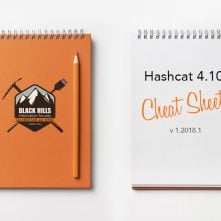
Hashcat 4.10 Cheat Sheet v 1.2018.1
Kent Ickler // It seemed like we were always cross-referencing the Hashcat Wiki or help file when working with Hashcat. We needed things like specific flags, hash examples, or command […]
David Fletcher// The following blog post is meant to expand upon the findings commonly identified in BHIS reports. The “Server Supports Weak Transport Layer Security (SSL/TLS)” is almost universal across […]
John Strand // This is the second part of our series about Attack Tactics, sponsored by our sister company, Active Countermeasures. In the first part we discussed how we’d attack. […]
Kent Ickler // Link-Local Multicast Name Resolution (LLMNR) This one is a biggie, and you’ve probably heard Jordan, John, me, and all the others say it many many times. LLMNR […]
John Strand // John is starting a new series of webcasts called Attack Tactics. This first part is a step-by-step walk-through of an attack BHIS launched against a customer, with […]
Bre Schumacher// Many of you were probably asked as a young child what you wanted to be when you grew up. Maybe you had an idea of something that sounded […]
Kent Ickler and Derrick Rauch* // Sun Protection Factor Err… wait a second. Sender Policy Framework Ladies and Gentlemen of the class of 1997, Wear Sunscreen…I will dispense my advice, […]
David Fletcher// The weak password policy finding is typically an indicator of one of two conditions during a test: A password could be easily guessed using standard authentication mechanisms. A […]
Paul Clark* // What is Software Defined Radio and why should you, the noble InfoSec professional, care about it? What kind of hardware and software do you need to start […]